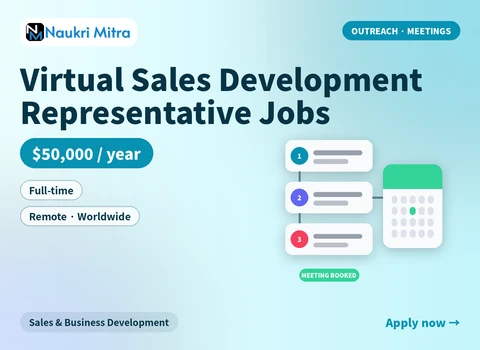
Here's the short version: this is a full-time, remote Sales Development Representative role paying up to $50,000 a year, and it's open to applicants anywhere.
What you'd actually be doing
The job is prospecting and qualifying new leads through calls, emails, and social outreach, then scheduling meetings for the account executives who take those conversations forward. You're not closing deals yourself. You're the person making sure the pipeline has real, qualified opportunities in it rather than a pile of names nobody's vetted.
A cold email that actually works
Picture a first email to a prospect that gets ignored, which happens constantly and isn't a sign anything went wrong. A week later, a short follow-up referencing something specific, maybe a product update the company just announced, gets a two-line reply asking for more detail. That's the job in miniature: most outreach goes nowhere, and the skill is in noticing which follow-up actually gives someone a reason to respond instead of just nudging the same message again.
Education and experience
A high school diploma or its equivalent covers the education requirement, though a bachelor's degree is often preferred where a candidate has one. In terms of experience, six months is the baseline, and it doesn't have to be sales specifically. Prior sales experience helps but isn't required, since a lot of what makes someone good at this role- comfort with rejection, clear phone and email communication- shows up in plenty of other jobs too.
Skills needed
- Comfort with CRM software for tracking leads and outreach
- Cold outreach across phone, email, and social channels
- Lead qualification, sorting a real opportunity from someone just being polite
- Clear communication, spoken and written
- Resilience, since most outreach doesn't land
Beyond that list, familiarity with a sales engagement platform, something that automates parts of an outreach sequence, tends to make ramping up faster. Some exposure to social selling on LinkedIn is a genuine plus too, since a decent share of qualified meetings now start there rather than from a cold call alone.
Pay and benefits
Base pay runs up to $50,000 USD annually; full-time, fully remote, with no location restrictions. Naukri Mitra lists this among a broader set of remote sales development representative jobs that pair a fixed base with commission tied to qualified meetings booked or opportunities that convert further down the pipeline.
- Health insurance
- Paid time off
- 401(k) matching
- Commission-based incentives
Many employers hiring for this kind of role also add life and disability coverage, which is worth factoring in alongside the base number when comparing offers.
What the volume actually looks like
This role runs on volume in a way a lot of other entry-level jobs don't. A rep usually works through dozens of outreach touches a day across email, phone, and social messages, and the math only works if a fairly small percentage of those actually convert into booked meetings. Most reps get one or two flat-out rude replies a week, and shaking that off quickly, rather than letting it color the next 10 calls, is part of what separates someone who lasts in this role from someone who burns out in a month.
Meeting quality matters as much as meeting quantity. A rep who books ten meetings that go nowhere for the account executive isn't doing better than one who books five that actually turn into real conversations, even though the first number looks stronger on a dashboard. Managers generally track both numbers side by side for exactly this reason, since optimizing purely for volume can quietly train a rep to book anyone willing to say yes rather than someone the account executive can actually work with.
How the team actually supports you
New SDRs usually get paired with a more experienced rep for the first few weeks, listening in on calls and reviewing sent emails before running outreach solo. Managers typically review a handful of recorded calls each week with each rep, less to critique every word and more to catch specific habits, talking over a prospect's objection instead of addressing it, for instance, before they calcify into something harder to unlearn later. That kind of structured feedback matters more here than in many remote roles, since there's no manager walking by to catch a rough call in the moment.
Tools you'll actually touch
Beyond the CRM itself, most SDR teams run on a sales engagement platform that automatically sequences outreach across email and phone, plus a dialer for call volume and some kind of intent or enrichment tool to prioritize which leads are actually worth contacting first. None of these require prior expertise walking in. Most companies train new hires on their specific stack during the first couple of weeks rather than expecting fluency on day one.
Getting in without prior sales experience
A lot of people land their first sales development representative job coming from retail, hospitality, or customer support rather than a previous sales title. What tends to matter most in an interview for someone figuring out how to become a remote sales development representative from a different background is a concrete story about handling rejection or a difficult conversation well, since that maps directly onto what the day-to-day actually requires.
Where this leads
SDRs who consistently hit their targets for six months to a year commonly move into account executive roles, taking over the closing side of deals they used to just set up. Others move into sales operations or marketing roles that support the pipeline from a different angle. A smaller number move into sales training or enablement, coaching newer SDRs the way they were once coached themselves. Neither of the first two paths is guaranteed with this specific opening, but all three are extremely common next steps out of an SDR seat.
How to apply
Applicants should be ready to describe their comfort level with high-volume outreach and cold contact specifically, since that's the part of the job that trips people up who otherwise look strong on paper. Applications are reviewed on a rolling basis, and the role stays open until it's filled.