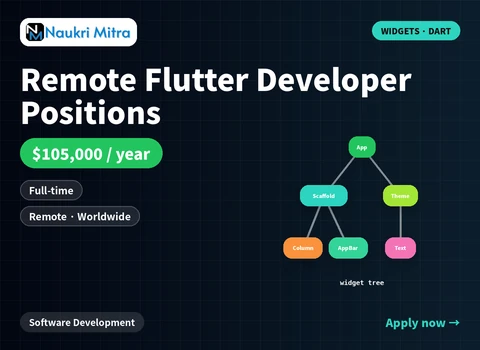
Remote Flutter developer role: $105,000 per year; open to anyone qualified, regardless of location. Full-time, on a software development team building cross-platform mobile apps from a single codebase rather than maintaining separate iOS and Android teams.
That single-codebase setup changes the shape of the job compared to many mobile openings. Instead of specializing in one platform's quirks, the work spans both platforms, and the trade-offs of writing shared UI logic that still needs to feel native on two very different operating systems show up constantly.
What you need
A bachelor's degree in computer science covers the education bar. Beyond that, 18 months of hands-on experience is required, along with a portfolio of cross-platform apps actually built in Flutter. Proficiency in Dart is expected walking in, not something to pick up on the job.
- Dart
- Flutter framework
- Mobile UI design
- REST APIs
- State management
- Git
App store screenshots don't tell a hiring manager much on their own. A downloadable build, a demo video, or a GitHub link showing real widget and state management work will make an application more seriously considered than a resume line claiming Flutter experience.
Extras worth having, none of them dealbreakers: familiarity with Firebase for authentication or push notifications, some exposure to native platform channels for the rare feature Flutter can't handle on its own, experience with a CI/CD tool built for mobile like Codemagic or Fastlane, and comfort writing widget or integration tests rather than shipping untested UI.
The App Store submission experience helps too, even though it rarely shows up as a required line item. Apple's review process in particular can reject a build for reasons that have nothing to do with code quality, from a screenshot that doesn't match the actual app to a permission request that isn't explained clearly enough, and someone who's been through that a few times moves through it faster than someone hitting it for the first time.
The actual work
- Build cross-platform mobile applications from a single Flutter codebase
- Integrate those apps with backend APIs
- Optimize app performance across both iOS and Android
Performance optimization means catching the platform-specific quirks that "write once, run anywhere" doesn't fully solve. A custom widget can render cleanly on a newer Android phone, but clip text or misalign padding on an older iOS device with different font metrics, and that gap only shows up once someone actually tests on real hardware rather than trusting the simulator. Chasing down that kind of inconsistency is a normal part of the week, not a rare fire drill.
API integration work runs the other direction too. A backend team might change a response format without clearly flagging it, and a Flutter app pulling that data needs error handling robust enough that a malformed response doesn't crash the whole screen. Building that resilience in from the start beats scrambling to patch it after a bad app store review.
Device fragmentation on Android adds another layer to the optimization work. A feature that runs smoothly on a current flagship phone can lag noticeably on a three-year-old budget device with a fraction of the memory, and part of the job is testing against that lower end rather than assuming everyone's running the latest hardware.
Pay and coverage
This one pays $105,000 annually. Health coverage and paid time off are included as standard, and being fully remote means the role isn't tied to any particular city or country. Life and disability insurance coverage often gets added on top of the base package at companies hiring Flutter developers at this level, though the exact mix varies by employer.
- Health coverage
- Paid time off
- Remote-work flexibility, open worldwide
Why Flutter, and what to expect
Flutter's whole pitch is one codebase instead of two, and that promise mostly holds up. Naukri Mitra sees Flutter developers move faster on new features than teams juggling separate Swift and Kotlin codebases, simply because there's one place to make most changes instead of two. It's not magic, though. Platform-specific bugs still happen, app store review guidelines still differ between Apple and Google, and someone on the team needs to understand both ecosystems well enough to navigate the differences.
State management deserves a specific mention here, since it's where many Flutter apps get messy over time. Whether a team uses Provider, Riverpod, or Bloc, the pattern matters less than consistency. An app with three different state management approaches scattered across screens is much harder to debug than one that picked an approach early and stuck with it.
Design collaboration matters more in Flutter work than some developers expect. Because the framework makes custom UI relatively fast to build, designers often hand over more detailed mockups than they would for a team using standard platform components, and translating that detail accurately takes a closer working relationship with design than a typical backend role would need.
Getting in and applying
Most people figuring out how to become a remote Flutter developer get there by putting something real into the world first. A weekend project that eventually turns into a working app on the Play Store, or an App Store listing with a few dozen downloads, teaches lessons that no tutorial covers, particularly around what breaks once actual users start poking at an interface. Eighteen months of hands-on Flutter work, paired with something shipped or nearly shipped, is generally enough to be competitive at this level.
The application itself should point a reviewer straight at evidence, not describe it secondhand. A link to a live app listing, a short screen recording of a feature in action, or a public repository with real commit history all work better than a bullet-pointed skills section. Given the pay and the 18-month bar, expect at least one technical conversation focused on real architecture decisions rather than surface-level trivia about widget syntax.