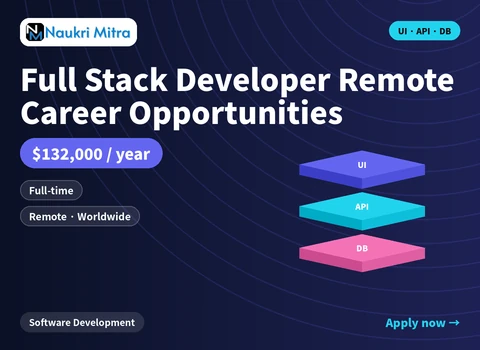
Full-time, fully remote, $132,000 a year. This Full Stack Developer role is open to candidates anywhere, and it's a build role, not a maintenance role. You'll be shipping features across the entire stack, front-end through database, on a team that ships regularly rather than in long stretches between releases.
The product itself is a web application with real users depending on it daily, not an internal tool or a greenfield rebuild. That distinction matters for how you'll spend your time; much of the work involves extending and improving something that already works, which requires a different kind of care than building from a blank slate.
The stack you'll work in
- JavaScript and Python
- HTML and CSS
- React on the front end, Node.js on the back end
- SQL and database design
- REST APIs
- Git for version control
- Cloud deployment
- Debugging across all of the above when something breaks in production
That's a wide list, and nobody expects mastery of every item on day one. What the team does expect is that you're already comfortable moving between layers, since a bug rarely announces which layer it's actually coming from. A slow page load might be a database query, a bloated API response, or unoptimized rendering on the client, and figuring out which one it is before you fix it is most of the skill. Someone who's only ever worked deep in one layer, say pure backend or pure frontend, will need to stretch into the other side here rather than staying in a lane.
What you'll actually build
Day to day, you're designing, building, and maintaining both the client-facing and server-side pieces of web applications. That includes writing and testing code across the stack, wiring up databases and APIs, and working directly with designers and product managers to turn a mockup or a spec into something that actually runs. Some weeks lean heavily toward one side of the stack depending on what's in the current sprint, but the expectation is that you can pick up either side without a long ramp.
A recent example from the team: a checkout flow redesign required integrating a new payment API on the backend, rebuilding the form on the frontend, and migrating the database to support saved payment methods, all coordinated with a designer who was iterating on the flow in parallel. That's the shape of the work here, not isolated tickets but connected pieces that need someone thinking across the whole system.
You won't be handed a fully specified ticket every time either. Products usually show up with a problem to solve rather than a finished design, and part of the job is working with them to figure out what the actual solution looks like before any code is written.
What gets you in the door
A bachelor's degree in computer science or a similar technical discipline is the baseline. What matters more is two years spent actually building both halves of an application, not favoring one side while treating the other as an afterthought. Show up with something you built end to end and put in front of real users, even a modest weekend project someone else actually used, and that will carry more weight in this process than a transcript full of finished courses.
The hiring team reads through code samples before anything else, looking specifically for whether a candidate can move comfortably between the browser and the server without needing a translator in between.
Familiarity with Docker or containerized deployment will strengthen an application, and so will any exposure to CI/CD pipelines or infrastructure-as-code tools like Terraform. None of that is required to apply, but candidates who already have it tend to get up to speed faster on this particular codebase.
People sometimes ask how to become a remote full stack developer without a traditional CS background, and the honest answer is that it happens, just less often at the two-year experience mark this role sits at. A strong self-taught portfolio can substitute for a degree in some cases, but it needs to demonstrate the breadth this role requires, not just one polished project in a single framework.
Compensation and benefits
Base salary is $132,000 a year, and this listing on Naukri Mitra reflects a full-time, permanent position rather than contract work. For candidates weighing this against other open remote full-stack developer jobs, the pay here sits solidly in the mid-to-upper range for the two years of experience this role is asking for.
- Employer-sponsored health insurance
- Paid time off
- 401(k) with employer match
- Remote-work flexibility
- A stipend for equipment or professional development, including courses and certifications
How the team actually works
Code review here is thorough, not rubber-stamped. Expect real feedback on pull requests, including pushback on approaches that work but aren't quite right for the codebase's overall structure. That can feel slow at first if you're used to moving fast and fixing things later, but it keeps the codebase from turning into something nobody wants to touch six months from now. It also means you'll learn the system faster than you would in a place where reviews are a formality.
Releases happen on a regular cadence rather than in big, infrequent batches, which means smaller, more frequent deploys and less time spent untangling a giant merge. Most engineers on the team say this is the part they'd miss most if they moved to a team with a slower release process. Standups happen daily but stay short, since most coordination happens asynchronously through pull request comments and a shared planning doc rather than live meetings.
Applying
Send a resume along with links to two or three projects you've built, deployed applications rather than local-only repos if you have them. A brief note on what you'd improve about one of those projects if you had more time is worth including too; it says more about how you think about tradeoffs than a polished demo does on its own. There's a short take-home exercise for candidates who make it past the initial screen, usually something scoped to take two or three hours rather than a full weekend. Applications are reviewed on a rolling basis, and there's no set closing date for this posting.