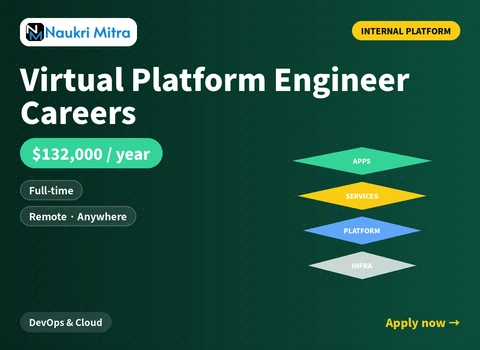
Virtual Platform Engineer opening: full-time, fully remote, $132,000 per year; location listed as Anywhere.
What the role needs
A bachelor's degree is required, generally in computer science. Beyond that, the role requires 2.5 years of hands-on experience building internal platforms and developer tooling, along with solid proficiency in cloud and automation technologies. This isn't a role for someone coming straight from application development without any infrastructure background; the day-to-day work sits squarely on the platform side.
Most candidates who fit this well have spent time building the kind of tooling that other engineers use without much thought. That's the point of the work. A platform engineer's best output is usually invisible to the teams it helps.
The two and a half years don't all need to come from a title with "platform" in it. Someone who spent that time as a DevOps engineer building shared CI/CD pipelines, or as an infrastructure engineer maintaining tooling used across multiple teams, fits the experience requirement just as well as someone with the exact job title on their resume.
What the work looks like
The core of the job is building and maintaining internal infrastructure platforms so development teams can deploy and scale applications without needing to understand every layer underneath. Developer experience work sits alongside that: improving the tooling engineers use every day so it gets out of their way instead of slowing them down.
Requests come in from other engineering teams constantly, and part of the job is deciding which are worth building for everyone and which are specific enough to a single team that they don't belong on the shared platform. Saying no to a reasonable-sounding request is sometimes the right call, and it's a judgment this role has to make regularly rather than escalating every time.
One of the platform team's projects last quarter reduced environment provisioning time from about two days to under an hour by replacing a manual, ticket-based process with a self-service pipeline. Work like that is fairly typical of what this role produces. It's less about shipping a single big feature and more about removing friction that's been accepted as normal for too long.
A good chunk of the job is also maintenance that doesn't show up on a roadmap: keeping Kubernetes clusters patched, tracking down why a CI pipeline started intermittently failing, updating internal documentation before it goes stale enough that people stop trusting it. None of that gets a launch announcement, but skipping it is how a platform slowly loses the trust of the teams using it.
Skills
- Cloud platforms
- Kubernetes
- CI/CD
- Infrastructure as code
- Internal developer tooling
- Scripting
Deep Kubernetes experience matters more here than broad cloud provider knowledge, since most of the platform already runs on a single cloud. A background in developer relations or technical writing isn't required, but it helps when the job involves documenting how a new tool is actually adopted, not just how it works.
Scripting ability gets used constantly in practice, usually for small glue work rather than large applications: a script to migrate configuration from an old format to a new one, a quick tool to check which services are still pointing at a deprecated endpoint. Python and Go both show up regularly on the team, and neither is required over the other.
Pay and benefits
The role pays $132,000 a year. Coverage includes medical insurance, a 401(k) match, and paid time off, and the fully remote setup means no location requirement tied to any office. Life and disability insurance round out the package, which is more common at this level than it is on junior listings.
Naukri Mitra is handling recruitment for this opening, and compensation is set at the offer stage rather than negotiated down through multiple rounds, so the number listed here is close to what a strong candidate should expect.
Reviews happen annually, with adjustments tied to scope rather than a fixed percentage. An engineer who's taken on ownership of a major piece of the platform, rather than just maintaining what already existed, tends to see that reflected the following cycle.
Team
The platform team is small relative to the number of engineers it supports, which is fairly standard for platform engineer jobs worldwide. What differs team to team is how much autonomy the platform group has over its own roadmap. Here, the team sets its own priorities based on what's actually slowing developers down, rather than working purely off requests filed by other teams.
Remote coordination happens mostly through written proposals before anything is built, which keeps decisions traceable and gives people time to weigh in properly rather than react in the moment. That slows some things down on purpose. A platform change that affects every engineering team deserves more scrutiny than a quick Slack thread can give it.
Disagreements about platform direction come up occasionally, since teams don't always want the same thing from shared tooling. The platform group makes the final call on architecture, but the process relies heavily on gathering input from the affected teams before making a decision, rather than presenting a final decision after the fact.
Anyone curious about platform engineer remote salary ranges relative to this one should know the number reflects a team that expects independent ownership from day one, not close oversight during a long ramp-up period.
Applying
Send a resume along with a short description of an internal tool or platform you've built or significantly improved, including what problem it solved for the team using it. Interviews consist of a technical conversation about platform architecture and tooling design, followed by a shorter call focused on how you've worked with other engineering teams as internal customers. Scheduling is flexible across time zones given the remote setup.
There's no fixed application window for this posting. It stays open until the right candidate is found, and applications continue to be reviewed on a rolling basis in the meantime.