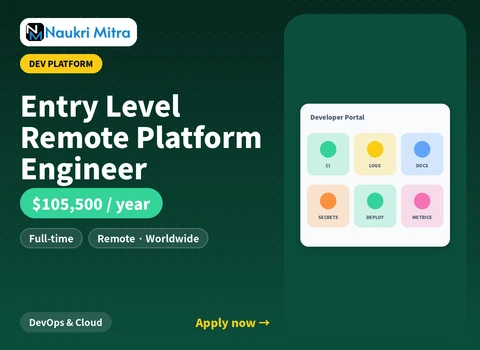
An entry-level, fully remote platform engineer role is open, paying $105,500 a year to candidates anywhere. It's a full-time position on a DevOps and cloud infrastructure team, and unlike many infrastructure roles, the actual customer here is other engineers rather than end users.
Every engineering team relies on a set of internal tools to actually ship their work, from deployment pipelines to the dashboards that show whether a service is healthy. This role helps build and maintain that layer, working alongside developers to identify what's slowing them down and fixing it at the tooling level rather than on a ticket-by-ticket basis.
Getting started
A bachelor's degree is the baseline, most commonly in computer science, even for an entry-level opening like this one. Ten months of hands-on experience building internal platforms or developer tooling is required, along with proficiency in cloud and automation technologies. This isn't a role for someone with zero practical background, but it doesn't demand years of production ownership either.
- Cloud platforms
- Kubernetes
- CI/CD
- Infrastructure as code
- Internal developer tooling
- Scripting
Anyone with exposure to Backstage or a similar developer portal framework will find that background directly relevant, since much of platform engineering work centers on providing developers a self-service way to find and use internal tools without filing a ticket. Familiarity with GitOps practices and reusable Terraform modules also translates well here, even without deep production experience.
A basic understanding of observability tooling, even from a personal project rather than a production system, is worth mentioning too. Being able to look at a service's metrics and logs and actually reason about what they show is a skill that develops faster with some prior exposure than with a completely from-scratch approach.
What the role does
- Build and maintain internal infrastructure platforms that let development teams deploy and scale applications efficiently
- Improve developer experience and internal tooling
Platform engineering is a little different from most infrastructure work because the people using what gets built are other engineers, not customers. A deployment CLI tool that silently swallows an error message, leaving a developer unsure whether their release actually succeeded, causes real frustration even though nothing technically broke. Fixing that kind of rough edge, making internal tools clear and trustworthy rather than just functional, is a core part of the job.
Improving developer experience often means noticing friction that experienced engineers have simply learned to work around. A deployment process that takes 15 manual steps might feel normal to someone who's done it a hundred times, but a new engineer joining the team will see each step as a barrier. Part of this role is building the tooling that closes that gap.
Kubernetes shows up constantly in this work, not as an abstract skill to list on a resume but as the actual layer most internal platforms get built on top of. Understanding how pods, services, and deployments fit together matters less for writing YAML by hand and more for troubleshooting why a self-service tool someone else built isn't behaving the way a developer expects.
Pay and benefits
The role pays $105,500 annually. Being fully remote means there's no location tied to the position, and the standard package includes 401(k) matching, time off, and medical coverage. Life and disability insurance coverage often gets layered on top of that base package at companies hiring for platform roles like this one, though the specifics depend on the employer.
- Remote-work flexibility
- 401(k) matching
- Paid time off
- Medical coverage
Why platform engineering, and what it's really like
Platform engineering has grown into its own discipline over the last few years, splitting off from general DevOps work as companies realized that building good internal tools requires dedicated focus rather than being squeezed between deployment tickets. Naukri Mitra sees this specialization appearing more and more in job postings, often replacing what used to be a general infrastructure role with something narrower and more product-focused.
Success in this role often gets measured differently than in a typical infrastructure job. Instead of uptime numbers, it's things like how quickly a new engineer can deploy their first change, or how many support requests a self-service tool eliminates. That shift in what counts as a win takes some adjustment for anyone coming from a more traditional operations background.
Working on a platform team also means the feedback loop is more direct than in a lot of infrastructure work. When a tool is confusing or broken, the developers using it say so quickly, usually in a shared chat channel rather than a formal ticket, and being comfortable receiving that kind of immediate, sometimes blunt feedback is part of what makes this work satisfying rather than draining.
Building toward this role
People wondering how to become a remote platform engineer without years of infrastructure experience often start by contributing to internal tooling at a smaller company, or by building developer-facing tools in a personal project, since platform engineer jobs with little required experience like this one still expect some hands-on evidence of the work. Ten months is a genuinely reachable bar for someone who's spent that time actually building rather than just observing.
Applications that stand out usually include a specific example: a script that automated a repetitive task, a small internal tool that saved a team time, or a contribution to an open-source developer tool. That kind of concrete evidence carries more weight in review than a resume that simply lists cloud platforms and CI/CD as skills without anything to back them up. Even a modest personal project, clearly explained, tends to land better with a hiring manager than an impressive-sounding list of tools with no story behind it.