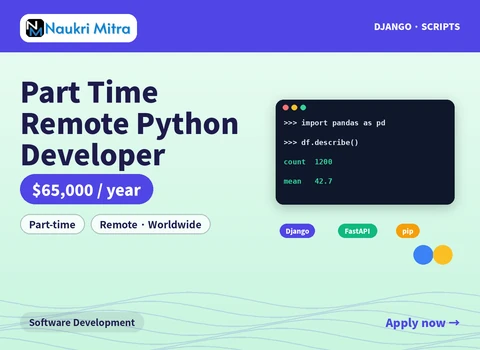
This is a part-time, fully remote Python Developer role paying up to $65,000 a year, open to candidates anywhere. If you've been hunting through remote part-time Python developer jobs hoping to find something that doesn't demand full-time hours, this one's worth a close look.
The team behind this listing works in the broader software development space, building backend services that support customer-facing products rather than internal tooling alone. Someone stepping into this seat would be joining an existing codebase, not starting one from scratch, which matters for how quickly you're expected to get comfortable with the existing patterns and conventions already in place.
The work
You'll be designing and building backend applications and services in Python, day in and day out. That's the core of it. Beyond writing the application code itself, you're expected to write automated tests as a standard part of the shipping process, not an afterthought tacked on when someone complains. And because backend work rarely happens in a vacuum, you'll be coordinating regularly with designers, frontend engineers, and product folks to get features out the door in working condition.
- Design and build backend applications and services using Python
- Write automated tests to cover new and existing functionality
- Collaborate with cross-functional teams to ship reliable features
- Debug production issues and support ongoing maintenance of live services
- Participate in code reviews to keep the codebase consistent and maintainable
Picture a scenario where a checkout endpoint starts timing out under load during a promotional sale. Diagnosing that, tracing it back to a slow database query, and shipping a fix without breaking three other things downstream is a fair snapshot of what a rough week here can look like. A quiet week might just mean building out a new internal API from scratch.
The collaboration side of the role matters as much as the coding itself. Backend work rarely gets built in isolation; a new endpoint usually needs sign-off from whoever owns the frontend that will consume it, and a schema change often requires a conversation with whoever runs reports on that data. Being able to explain a technical trade-off in plain language to someone who isn't a developer is just as valuable as the code itself.
What you'll need
A bachelor's degree covers the education bar for this one. In terms of experience, the team wants two years of hands-on Python development under your belt, ideally with some exposure to a production environment rather than only side projects. That two-year mark isn't arbitrary: it's roughly the point where most developers have shipped enough real features to have opinions about how they'd structure things differently next time, and those opinions tend to be useful on a team.
- Python, with real fluency, not just familiarity
- Django or Flask experience
- SQL and comfort working directly with relational databases
- REST API design and integration
- Git for version control
- Experience with a testing framework such as pytest or unittest
- Some exposure to cloud deployment, whether that's AWS, GCP, or Azure
None of these need to be mastered on day one. A developer who's genuinely strong in Python and SQL but has only touched Django briefly, for instance, can usually pick up the rest of the stack within the first few weeks on the job.
Bonus points, though none of these are required, for prior experience with Docker, message queues like Celery or RabbitMQ, or a background in an agile team environment. Naukri Mitra frequently sees candidates land roles like this one even without every bonus item checked off, so don't rule yourself out over a gap in the nice-to-haves. What tends to matter more in practice is how someone approaches a bug they haven't seen before: whether they reach for the debugger and read the actual error, or start guessing.
Pay and benefits
The role pays up to $65,000 annually, prorated to part-time hours, which puts it in a reasonable range for part-time remote Python developer jobs at this experience level. Anyone comparing Python developer remote salary numbers across listings should factor in that part-time compensation scales down relative to full-time equivalents.
- Health insurance coverage
- Paid time off
- 401(k) matching
- Remote-work flexibility with no fixed location requirement
- Learning stipend or tuition reimbursement for continued skill development
Larger employers hiring for roles like this one tend to offer tuition or a learning stipend on top of the baseline package, so the exact benefits mix can shift depending on company size. Health coverage and PTO, by contrast, are close to standard across the board at this level.
Schedule and flexibility
Part-time here generally means 20 to 25 hours a week, with the exact split negotiable depending on the employer's needs and your availability. Most of the day-to-day communication happens asynchronously, through written updates and code review comments, so you won't need to be logged in during a fixed nine-to-five window. Meetings, when they happen, tend to be scheduled with enough notice that they don't unexpectedly eat into focused coding time.
This setup tends to suit people juggling the job alongside something else, whether that's freelance work, a degree program, or family responsibilities that make a rigid schedule impractical. It's less of a fit for someone who wants tight day-to-day mentorship or the kind of constant back-and-forth that a busy full-time team provides, since a smaller time commitment naturally comes with more independence expected of you. For anyone building toward a remote Python developer career without wanting to commit to a full 40-hour week right away, a role structured like this one is a realistic starting point.
Applying
Send a resume along with a link to code you've written, whether that's a GitHub profile, a deployed side project, or a sample from prior work you're free to share. Mention which framework, Django or Flask, you've spent the most time in, since that's usually the first thing a hiring manager will ask about. Applications are reviewed as they come in rather than in batches, so earlier submissions tend to be reviewed sooner. If you make it to a conversation, expect it to center on a specific project you've built rather than abstract trivia questions about language syntax.