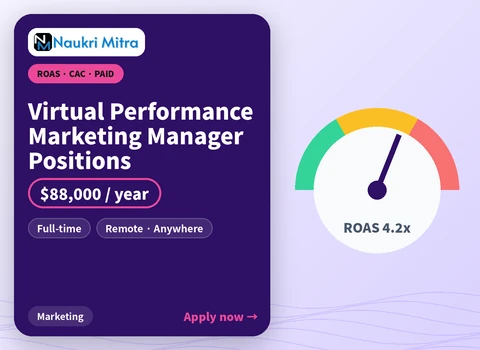
Remote Performance Marketing Manager, full-time, paying up to $88,000 a year, open to candidates anywhere. This one comes with a real budget attached, so the person in this seat is directly accountable for whether that money actually turns into customers. It's a numbers-first role more than a creative one, though the two aren't unrelated, and the person hired needs to be equally comfortable defending a decision with a spreadsheet as explaining it in plain language to someone who isn't a marketer.
What the role covers
- Decide where paid budget goes across channels and keep those campaigns actually running day to day
- Shift spend around based on what's actually returning value, not just what looked good in last month's plan
- Put together a clear read for leadership on how the numbers are trending and why
A channel that looks profitable on a simple last-click view can look completely different once you account for how customers actually moved through several touchpoints before converting, and untangling that gap between the two pictures is a real part of the job, not a rare exception. Some months are mostly steady optimization. Others involve pulling spend out of a channel entirely because a platform update quietly changed how it performs. A mid-month budget shift like that usually means reallocating within days, not waiting for the next planning cycle to catch up.
An ad account getting flagged and temporarily suspended over a policy violation nobody flagged in advance can wipe out a week of planned spend overnight, and having a response plan ready for that scenario matters more than people expect walking in. Getting an account reinstated usually takes longer than anyone wants, so knowing where to reroute spending in the meantime is its own kind of preparation.
Background needed
A bachelor's degree in marketing covers the education piece, paired with two and a half years of real ownership of paid spend that spanned multiple channels at once, not just running ads within a single platform. Being comfortable making a call based on what the numbers actually show, rather than gut feel or last quarter's habit, is assumed rather than trained here.
Two and a half years is generally enough to have managed a budget through at least one real downturn, a quarter where cost per acquisition crept up for reasons that took real digging to fully explain. Living through that once changes how someone approaches spend decisions afterward. It also tends to be enough time to have made at least one call that looked wrong for a few weeks before it paid off, and to have had the patience to let it play out instead of reversing course too early.
Skills that matter here
Hands-on paid media management sits at the core, across at least a couple of the major ad platforms rather than just one. Analytics and budget management go hand in hand, since knowing the numbers only matters if you're also the one deciding where the next dollar goes. A/B testing gets applied constantly to creative, audiences, and bidding strategy alike, and cross-channel campaign strategy ties the individual pieces into something coherent rather than a handful of disconnected efforts. Someone who's only ever run one platform tends to underestimate how differently the same budget behaves once it's split across three or four. Beyond that core set, a few things aren't required but genuinely help: experience with attribution modeling beyond basic last-click, some exposure to incrementality testing, familiarity managing an outside agency alongside in-house spend, and comfort forecasting customer lifetime value well enough to justify a higher acquisition cost on a specific channel. None of these will keep a strong candidate out, but a background running budgets in a specific vertical, like ecommerce or subscription services, usually translates faster than people expect, since the unit economics logic carries over even when the product doesn't.
Pay and what's attached
Base pay tops out around $88,000 a year, with a performance bonus layered on top tied to how campaigns actually perform against target. Medical coverage, real vacation time, and a 401(k) match round out the baseline package. A lot of companies in this space also run formal review cycles that include a raise when the numbers actually justify it, rather than leaving pay increases to chance or tenure alone. Worth asking directly what "performance" means for bonus purposes, since teams sometimes reward hitting a spend target even when the resulting customers weren't especially valuable, which isn't always the incentive you'd want built in.
Remote reality
This is a remote performance marketing manager role with no location tied to it, so most of the day is spent in ad platform dashboards and on a handful of recurring calls rather than in a shared office. Naukri Mitra sees strong candidates for roles like this fairly often coming from agency backgrounds, mainly because agencies expose candidates to multiple clients' budgets and platforms at once in a way a single in-house team rarely does. That range tends to build faster instincts than staying within one company's budget would.
The isolating part of doing this alone is that a bad week in the numbers can feel personal fast, with no one nearby to talk it through in real time. Building a habit of getting a second opinion from a manager or peer before making a big budget swing helps more here than in jobs with more built-in oversight. A quick sanity check from someone else catches more mistakes than most people expect.
Applying
Send a resume along with one example of a budget decision you made that actually moved performance, including roughly what changed and what the results looked like afterward. Shortlisted candidates will work through a sample budget-allocation scenario during the interview and explain their reasoning out loud. There's usually a short follow-up conversation after that with whoever currently owns the acquisition budget, mostly to see how your instincts on tradeoffs line up with theirs. Expect the process to run about two to three weeks from application to offer.