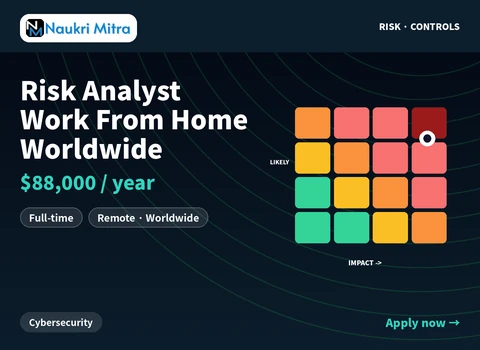
A risk analyst role is open, fully remote, work from home worldwide, paying $88,000 a year. It's a full-time cybersecurity position, though the scope here is broader than security alone, covering operational and financial risks as well.
Every organization carries risk it doesn't fully see until someone maps it out deliberately. This role does that mapping: pulling together threats that might otherwise sit in different departments' blind spots and putting them in front of the people who can actually decide what to do about them.
What the work involves
- Identify and evaluate the risks an organization is actually carrying
- Develop strategies to reduce or manage those risks
- Prepare reports for leadership on risk exposure and compliance status
A risk register where nearly everything gets marked "high" is a common trap, and it happens for an understandable reason: nobody wants to be the person who downgraded a risk that later turns into a real problem. The result is a list that no longer helps anyone prioritize, since if everything is critical, nothing actually is. Pushing back on that instinct and applying consistent, defensible criteria across every risk, even the ones that feel uncomfortable to rate lower, is part of making a risk register genuinely useful rather than just a long list everyone ignores.
Individual risks rarely remain isolated from one another. A gap in vendor oversight might look acceptable on its own, and a delay in patching a specific system might also look acceptable in isolation, but combined, they can create an exposure neither risk would suggest by itself. Spotting that kind of compounding effect takes looking across the full risk picture rather than evaluating each item purely on its own terms.
Reporting to leadership means translating technical or operational detail into something a non-specialist can actually use to make a decision. A finding written the way it would appear in a technical audit report tends to get skimmed and set aside, while the same finding framed around a concrete business consequence- what could actually happen and what it would cost- gets real attention in a leadership meeting.
What's required
A bachelor's degree opens the door here, and it doesn't have to be a security-specific one. Finance, cybersecurity, and other closely related fields all show up among people doing this work well. Candidates need 30 months of hands-on experience assessing operational, financial, or security risk, along with strong analytical and reporting skills.
- Risk assessment frameworks
- Data analysis
- Compliance standards
- Reporting
- Excel
- Communication with stakeholders
Familiarity with a formal risk quantification method, such as the FAIR framework, tends to stand out, since translating a vague sense of risk into a specific dollar figure changes how seriously leadership takes a finding. Some background in business continuity planning, hands-on experience with a dedicated risk register or GRC platform, and comfort assessing third-party or vendor risk will all strengthen an application.
Genuine comfort in Excel goes beyond basic spreadsheet use for this role. Building a model that lets leadership see how a risk estimate changes under different assumptions, rather than presenting a single fixed number, gives decision-makers a much clearer sense of how confident they should actually be in the figure they're looking at.
Pay and benefits
The role pays $88,000 annually. Retirement plan matching comes alongside paid time off and health insurance as part of the standard package. Employers hiring at this level commonly add life and disability insurance coverage on top of that base package.
- Retirement plan matching
- Paid time off
- Health insurance
- Life and disability insurance coverage
Turning uncertainty into something leadership can act on
Risk work sits in an odd spot between hard data and genuine judgment calls, and communicating that mix clearly to leadership is a skill in itself. Naukri Mitra sees this tension show up often in how risk reports land with an executive audience: leadership frequently wants a single number they can track over time, while the reality underneath that number is a collection of separate, genuinely hard-to-compare risks that don't reduce cleanly into one clean metric without losing something important in translation.
Mitigation strategies have to account for what an organization can realistically do, not just what a textbook risk framework recommends. A theoretically ideal fix that would take eighteen months and a budget nobody has approved isn't useful guidance on its own, and part of the job is proposing something a business can actually act on now, alongside the longer-term recommendation, rather than presenting only the perfect solution and leaving leadership to figure out the gap themselves.
Working with stakeholders across finance, operations, and technical teams means each group tends to weigh the same risk differently. Finance might care most about dollar exposure, while an operations team focuses on whether a fix disrupts a process customers depend on, and reconciling those different priorities into a single coherent recommendation is a real part of the job that doesn't show up in a skills list.
Getting there and applying
A remote risk analyst salary at this level reflects a role that blends quantitative skills with strong communication skills, since a risk assessment that never gets acted on because leadership can't follow it accomplishes very little. People asking how to become a remote risk analyst often come from an analytical background in finance, audit, or general business analysis, then develop specific risk assessment expertise on top of that foundation.
Applicants should be ready to describe a specific risk they identified and the mitigation strategy they proposed, including how leadership received that recommendation and what happened afterward. That kind of concrete example tells a hiring manager far more about practical judgment than a general list of frameworks and tools, since getting a real recommendation actually adopted is a different skill than producing a technically sound report that sits unread.