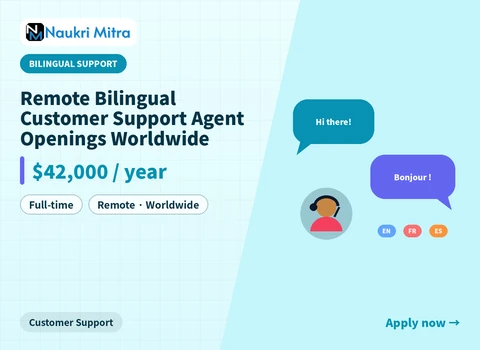
Being bilingual is the whole reason this remote Customer Support Agent role exists, and it pays for that fact directly: up to $42,000 a year, full-time, open to applicants anywhere in the world.
The language piece
Fluency in English plus at least one other language is the baseline here, not a nice bonus tacked onto a regular support job. Agents move between languages depending on who's on the other end of the chat or call, sometimes within the same shift, sometimes within the same conversation if a customer switches partway through. Beyond the language itself, the role requires general customer service skills, active listening, comfort with help desk software and CRM tools, and problem-solving that holds up even when a customer is speaking in their second language and struggling to find the right word.
A third language isn't required, but agents who have one tend to get pulled into a wider range of queues, which usually means steadier hours during slower stretches for other languages. Familiarity with a translation memory tool or glossary system is useful too, mainly because it keeps terminology consistent across agents handling the same product in different languages, so a feature doesn't get five different names depending on who last documented it.
What the day looks like
- Assisting customers in more than one language across phone, chat, and email
- Resolving inquiries and complaints as they come in
- Documenting every interaction in the company's support system
A shift rarely stays in one language for long. An agent might close out an English email thread, pick up a chat in Spanish about a shipping delay, then take a call where the customer opens in English but drifts into their first language once they get frustrated. Following that shift without losing track of what's actually been promised to the customer is most of the job.
Education and experience needed
The education bar is a high school diploma or its equivalent, nothing beyond that. Experience-wise, the role calls for 12 months of customer service work, ideally with some of it involving more than one language, though a full year of monolingual support experience paired with strong fluency in a second language usually satisfies it as well.
Pay, schedule, and where you can work from
This is a full-time position paying up to $42,000 USD annually, and it's genuinely remote with no country restriction attached, which puts it among the bilingual customer support agent jobs worldwide that don't require relocating or working a specific region's hours exclusively. Naukri Mitra also lists part-time versions of similar bilingual roles elsewhere, though this particular opening is full-time.
Benefits
- Health insurance
- Paid time off
- A shift differential tied specifically to language skills
That last one matters more here than in most support roles, since it's compensation attached directly to the bilingual requirement rather than a generic perk. Agents who work shifts where the second-language volume runs heavier typically see that reflected in pay, not just workload.
Where the job gets genuinely hard
Translation isn't the difficult part for most agents doing this well. The harder part is tone, since a phrase that reads as polite and calm in one language can come across as blunt or cold when carried directly into another without adjusting for it. An agent who's fluent but doesn't adjust tone across languages ends up with more escalations than one who's slightly less fluent but reads the room correctly in both. That's a real skill gap the role tests for, even though it rarely shows up explicitly in a job posting.
Documentation carries extra weight too. A note written in English about a conversation that happened partly in another language needs to be clear enough that a teammate who doesn't speak that second language can still pick up the case without confusion. Sloppy notes here cause more repeat contacts than almost anything else on this kind of team.
Who tends to do well?
People who grew up speaking two languages at home, or who've worked retail or hospitality in a bilingual community, generally adjust to this fastest, since they're already used to switching mid-sentence without thinking about it. Someone who learned a second language formally, through school or a course, can absolutely do this work too, but usually needs a bit more time to get comfortable with the informal, fast-moving version of that language customers actually use.
Getting into this kind of role without prior bilingual experience usually requires just a year of regular customer service work plus genuine conversational fluency in a second language. Remote bilingual customer support jobs in this category tend to weigh actual language ability over formal certification, since there's rarely a test involved beyond the interview itself.
Covering languages across time zones
Since the role is fully remote and open worldwide, coverage for any given language often spans multiple time zones rather than being limited to a single region. A Portuguese-language customer writing in at what's late evening for one agent might land with a colleague several hours away for whom it's the middle of their workday. That handoff only works cleanly if the documentation from earlier in the conversation is complete enough that the next agent isn't starting from zero, which is part of why the documentation expectation is emphasized as much as the language skill itself.
Growth path
Bilingual agents who stay a year or two commonly move into team lead roles overseeing a specific language queue, or into quality review positions checking translated documentation for accuracy. Some move into localization or content roles if writing turns out to be more their strength than live conversation. None of that is promised with this specific opening, but it's a well-worn path in bilingual support work.
How to apply
Applicants should be ready to demonstrate fluency directly, not just claim it, and to describe prior customer service experience along with any CRM or help desk tools they've used. Applications are reviewed on a rolling basis, and the role stays open until it's filled.