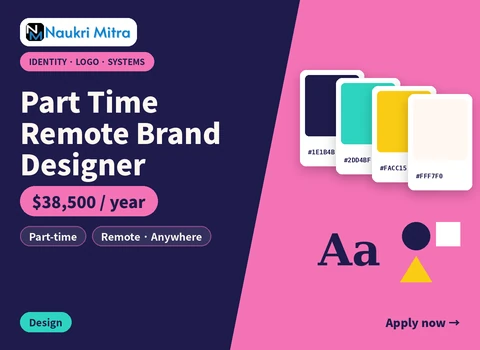
This one's part-time: a remote brand designer role open to candidates anywhere, paying up to $38,500 a year on a part-time schedule. It suits someone who wants real, ongoing brand work without committing to a full 40-hour week, whether that's because of freelance clients on the side, another job, or just a preference for fewer hours.
What the job actually involves
The designer in this seat builds the visual foundation a company runs on: the mark itself, the color palette that pairs with it, and the wider identity system that holds everything together across different touchpoints. Once that foundation exists, the work shifts toward documenting it clearly enough that other people- an internal marketing team, an outside agency, a freelancer- can apply it correctly without guessing.
- Design logos, color systems, and the broader visual identity that a brand is built around.
- Put together brand guidelines that spell out how the identity should be used, and where the boundaries are.
- Review marketing materials as they go out to make sure the brand's actually being applied the way it was designed.
A coffee roaster expanding from one storefront to wholesale accounts is a realistic project here. The original logo might have worked fine on a single sign, but suddenly it needs to hold up on a shipping label at half an inch tall, on a website banner, and on a delivery truck. Making one identity flex across all of that without losing what made it recognizable in the first place is the kind of problem this role exists to solve.
The guideline document itself deserves more attention than it usually gets in this kind of role. It's tempting to treat it as paperwork that comes after the real design work is done, but a vague or incomplete guide is exactly how a carefully built identity ends up inconsistent six months later, once a dozen different people have applied it their own way.
What it takes to get considered
A four-year design degree, with a focus somewhere between graphic design and visual communication, covers the education side of things. What tends to matter more in review is a portfolio built specifically around brand and logo projects, not a general design grab bag. Strong typographic instincts and the ability to tell a visual story without leaning on gimmicks both show up as baseline expectations here.
On the experience side, the company is asking for 24 months of relevant work.
- Adobe Creative Suite
- Brand identity design
- Typography
- Logo design
- Style guide creation
- Creative direction
Beyond the basics
None of the following are required, but they'll make an application stronger. Package or product design experience helps, since much brand work eventually touches physical packaging rather than just a screen. Basic logo animation, even something simple built in After Effects, is increasingly expected as brands move onto video and social. Some art direction experience in photography also helps, since a brand's visual identity usually extends to how its photos are shot and lit, not just how its logo sits on a page. A working knowledge of print production basics, like knowing what bleed and color mode mean before a file goes to a printer, rounds things out well too.
Pay and what's included
Pay for this role tops out at $38,500 a year, prorated to a part-time schedule. Health coverage, paid time off, and remote-work flexibility are part of the package. Naukri Mitra also flags that some employers hiring for part-time remote brand designer jobs include a wellness stipend or a home office equipment allowance, though eligibility for that kind of extra sometimes depends on hours worked, so it's worth confirming directly during the hiring conversation.
Brand designer remote salary figures for part-time roles obviously run lower than full-time equivalents, and this one lands in a reasonable spot for someone splitting their time across multiple clients or projects.
How the schedule actually works
Part-time here doesn't mean loosely defined. There's a set number of hours expected each week, and the work tends to cluster around specific deliverables, a logo concept round, a guideline document, a review pass on new marketing assets, rather than being spread evenly across every day. Someone balancing this with freelance clients or a second job should expect the hours to be somewhat predictable but not perfectly flexible, since brand projects still run on deadlines set by others.
Communication happens mostly async, through shared files and written comments rather than frequent calls, which fits a part-time arrangement better than a schedule full of live meetings would. A designer working fewer hours a week still needs to be reachable during a reasonable window each day, though, since brand decisions sometimes need a quick answer rather than a response that arrives the next morning.
People looking into how to become a remote brand designer sometimes assume part-time work means smaller or less serious projects. That's not really true here. The scope of the identity work is the same as in a full-time role, just delivered over fewer hours per week, which usually means tighter prioritization and less time for exploratory concepts that never go anywhere.
Applying
A portfolio focused on brand and identity work is required, ideally showing at least one project through from early concept to a finished guideline document. Applications are reviewed on a rolling basis, and candidates who move forward can expect a short conversation about availability and scheduling alongside the usual portfolio review, since fitting a part-time schedule around existing commitments matters just as much here as the design work itself. There's no set closing date on this posting, so it stays open until the right fit is found.