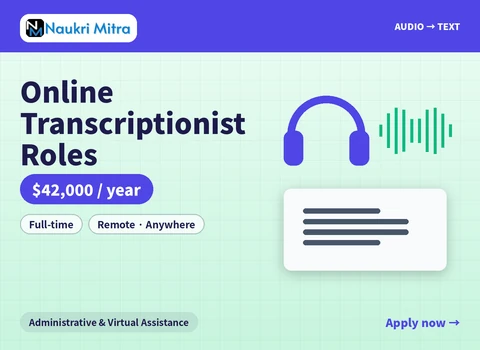
This Online Transcriptionist role is full-time, fully remote, and open to applicants anywhere. It pays $42,000 a year. The work involves turning spoken audio into clean, accurate written text, which sounds simple until you're three minutes into a recording with two people talking over each other. It's a role that rewards patience and precision more than raw speed alone.
Skills the role depends on
- Fast and accurate typing
- Active listening
- Transcription software
- Grammar and punctuation
- Attention to detail
Active listening matters more here than in most typing-heavy jobs. Miss the difference between a muffled word and its near-sound-alike, and the meaning of a whole sentence can flip on you, so actually following the conversation beats mechanically converting noise into letters. Deciding where one spoken thought ends and the next begins falls to the transcriptionist too, since real speech rarely breaks into tidy sentences the way written language does. Getting comfortable with a transcription platform matters, particularly one where you can slow a clip down or use a hands-free control to replay a section, since that combination is usually what separates someone who finishes a file efficiently from someone who falls behind on it.
What a file actually involves
- Listen to audio or video recordings and convert them into accurate written text
- Proofread transcripts for errors before submission
- Meet deadlines for turnaround on assigned files
A recorded panel discussion with three speakers, a bad microphone, and someone's dog barking in the background is the kind of file that separates an experienced transcriptionist from a newer one. It usually means slowing playback, listening to the same fifteen seconds three or four times, and making a judgment call on a word that's only partially audible, rather than guessing and moving forward. Proofreading catches most of what slips through on a first pass, things like a name spelled inconsistently across a document or a sentence that trailed off mid-thought and needs a clean mark to show it.
Turnaround deadlines vary by file length and complexity, but they're real deadlines, not loose suggestions. A one-hour recording with clear audio might take two to three hours to transcribe properly, while a rough one with cross-talk can take considerably longer. Style guidelines from the employer usually dictate details like whether filler words get included or cleaned up, and following those consistently across a batch of files matters as much as getting individual words right.
What you'll need to apply
A high school diploma or its equivalent covers the education requirement. Alongside that, six months of relevant experience is expected, whether that came from a prior transcription role, closed captioning work, or another job that involved heavy, accurate typing under time pressure. Six months is a reasonable starting point for this kind of work, not a high bar meant to filter out newcomers. Someone with strong typing skills and genuine listening patience can often ramp up quickly, even coming from a field that isn't transcription-specific.
Naukri Mitra notes that candidates with a background in court reporting, medical scribing, or subtitling tend to pick up the pace in this role quickly, since those fields all demand the same core skill: converting speech to text without losing accuracy. Bilingual candidates sometimes find additional file types available to them, though that isn't a requirement for this particular listing.
Pay and what comes with it
- Flexible scheduling
- Health coverage
- Paid time off
The $42,000 salary applies to this full-time, salaried position rather than a per-file freelance arrangement. For anyone comparing transcriptionist remote salary figures, that distinction matters, since per-file pay structures common elsewhere in this field can look different on paper. Flexible scheduling means you can generally choose which hours you work, as long as assigned files get returned by their deadlines. Health coverage enrollment follows a standard waiting period typical for full-time roles, and PTO builds up from your first pay cycle rather than being withheld until a later date.
What the workload actually feels like
Some files move quickly: clear audio, one speaker, straightforward content. Others take far more time than their length would suggest, particularly interviews with crosstalk or recordings made in noisy environments. The pace of a given week depends heavily on which files land in the queue, so output can vary even when effort stays consistent. Building a mental library of common terminology, whether that's medical vocabulary, legal phrasing, or industry-specific jargon depending on the client, speeds up files considerably once it's in place.
People looking into how to become a remote transcriptionist often assume typing speed alone determines success, but listening accuracy and judgment on ambiguous audio matter just as much, sometimes more, especially once you're working with lower-quality recordings. The strongest transcriptionists tend to be people who genuinely don't mind replaying a difficult section multiple times to get it exactly right rather than settling for close enough.
Applying
Send a resume along with any relevant transcription or typing-under-pressure experience you have. A short transcription test is a standard part of the process, usually a five- to ten-minute audio clip you'll transcribe and submit for review. Applications are reviewed on a rolling basis, and candidates who pass the test can expect a follow-up within about a week. The test itself is a fair reflection of the daily work, so treating it seriously matters more than trying to guess what reviewers are looking for.