React Developer, Remote
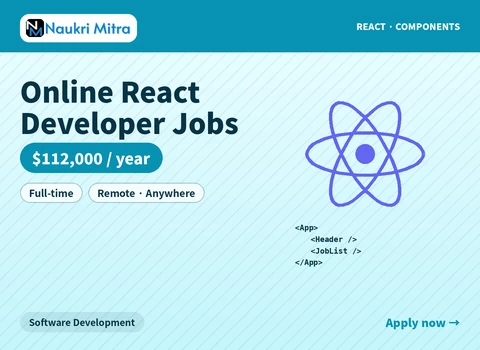
This is a full-time, fully remote React Developer role paying $112,000 USD per year, open to applicants anywhere. The team builds and maintains the interfaces customers actually touch, so the work sits close to product decisions rather than off in a support function somewhere down the line. Because the position is remote with no fixed location requirement, the schedule leans on a few hours of overlap with the rest of engineering rather than a strict nine-to-five in any particular time zone.
The React codebase supports a live product with real traffic, not an internal tool used by a handful of people, so changes ship to actual users regularly. That raises the bar on testing and code review a little, but it also means the work is visible: a component built this month is likely to be touched by a customer by next month.
What the role involves
Day-to-day, this developer builds and maintains user interfaces in React, working from design files and product requirements to ship components that hold up under real traffic. Application state needs to stay predictable as features get added, which means regular back-and-forth with backend engineers about how data moves through the app. Here's what that looks like in practice.
- Build and maintain user interfaces using React, translating design files into working components
- Manage application state as the codebase grows, keeping data flow predictable across features
- Partner with designers to turn mockups into responsive, working pages
- Work with backend developers to define and consume REST APIs
- Take part in code review, catching issues before they reach production
- Debug issues reported from production, tracing them back to the component or state change that caused them
None of this happens in isolation. Designers hand off Figma files that need interpretation, not just implementation, and backend engineers are often mid-build on the same feature, so the API contract sometimes shifts after the frontend work has already started. Handling that kind of moving target is a normal part of the job, not an exception.
Education and experience
A bachelor's degree is expected for this role, most often in a technical discipline, along with a portfolio of production React applications a candidate can point to. Eighteen months of hands-on React experience is the target. Proficiency in modern JavaScript and component-based architecture matters more here than any particular certification, since most of what shows up in a workday is judgment calls about structure rather than trivia.
A strong portfolio for this role usually shows more than a single tutorial project. Reviewers are looking for evidence of state management under real conditions, some sense of how the candidate structures components as an app grows beyond a few screens, and, ideally, at least one project that involved consuming a live API rather than static mock data. Personal projects count as long as they're substantial and the candidate can speak to the decisions behind them.
Skills
The required toolkit centers on React itself, plus the pieces that make a React app maintainable at scale.
- React
- JavaScript and TypeScript
- HTML and CSS
- State management, particularly Redux
- REST APIs
- Git
None of the following are required, but each one will strengthen an application: experience with Next.js, familiarity with GraphQL, exposure to a component library such as Storybook, comfort writing tests in Jest or React Testing Library, and some working knowledge of accessibility standards like WCAG. A candidate who has shipped even one of these in a real project usually stands out from one who has only read about it. TypeScript, in particular, comes up constantly once a codebase reaches a certain size, since the type errors it catches tend to be the same ones that would otherwise surface as bugs weeks later.
Pay and benefits
At $112,000 per year, the pay is toward the higher end of what similar remote React developer jobs typically offer at this experience level, and it's paid in USD regardless of where the candidate is based. There's no relocation involved and no office to move near; the role is listed as remote, full-time, with location set to anywhere.
- Health coverage
- Paid time off
- 401(k) matching
- Remote-work flexibility, with no fixed office to report to
- Access to a counseling and wellbeing benefit outside the standard health plan
Equipment and any tooling licenses needed to do the job are provided rather than expected out of pocket. Time off is tracked but not rigidly policed; the general expectation is that people take it and coordinate coverage with their team in advance.
Team and day-to-day
Sprint planning happens on a regular cadence, and this developer sits in those meetings alongside designers and backend engineers rather than working from a spec handed down after the fact. Naukri Mitra posts openings like this one because remote React work has expanded beyond the major tech hubs over the past few years, and companies hiring for it now compete on pay and flexibility rather than office location.
Release weeks tend to run heavier than the rest of the sprint, and this developer should expect real-time code review as the codebase grows and more people touch the same components. That's a normal part of working on a shared frontend, not a sign that anything is off. Communication happens mostly in writing, through pull request comments and a team chat channel, with a standing video call a couple of times a week for anything that's faster to talk through than type out.
Mentorship runs in both directions on this team. A developer with eighteen months of experience is expected to ask questions freely and to start answering some of them for whoever joins next, once they've had a few months to get familiar with the codebase.
How to apply
Send a resume along with links to at least two production React projects, whether from previous employment or well-documented personal work. A brief note on the specific role each project played in state management or component design is more useful than a long cover letter. Applications are reviewed on a rolling basis. Shortlisted candidates can expect an initial screening call, followed by a technical exercise focused on component design and state management, and a final conversation with the team before an offer goes out.