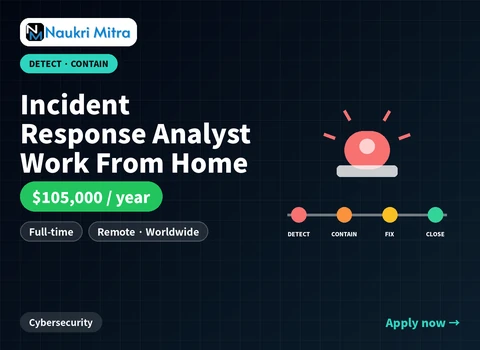
Incident response analyst, work from home, $105,000 a year, full-time. This one's in cybersecurity, and it's built around the moment something has actually gone wrong, not just watching for signs that it might.
Every other role in a security team exists to prevent this moment or catch it early. This one exists for when prevention already failed, and something real needs to be untangled, contained, and understood well enough that it doesn't happen the same way twice.
What the work involves
- Detect, investigate, and contain active security breaches
- Run forensic analysis on systems that have been compromised
- Document findings well enough that they actually improve future defenses
By the time most incidents get noticed, the attacker's already been inside for a while. An alert that finally triggers attention often marks the moment something became visible, not the moment the actual compromise happened, and forensic work means reconstructing that earlier timeline: how the attacker got in originally, what they touched along the way, and how long they'd been sitting there before anything looked wrong. That gap between initial access and detection is usually where the most useful lessons for preventing a repeat actually live.
Containment decisions happen under real pressure, often with incomplete information and a business that wants systems back online immediately. Pulling a compromised system offline stops the bleeding but can also destroy volatile evidence that only exists in memory, and knowing when to capture that evidence first versus when the risk of letting an attacker stay active outweighs the forensic value takes real judgment built from experience, not a fixed rule that applies every time.
Malware analysis adds another layer to the investigation, since understanding what a piece of malware actually does, not just that it's present, shapes the entire containment strategy. A sample that quietly exfiltrates data calls for a very different level of urgency than one primarily designed to spread laterally, and telling those apart quickly enough to matter requires genuinely reading and reasoning about the malware's behavior rather than relying solely on a signature match.
What's required
Cybersecurity or computer science, at the bachelor's level, is what's asked for here, and GCIH shows up often enough among incident responders that it's worth treating as a genuine expectation rather than a nice-to-have. Candidates need 2.5 years of hands-on experience investigating and containing real security incidents.
- Digital forensics
- SIEM tools
- Malware analysis
- Incident handling procedures
- Threat intelligence
- Communication under pressure
Hands-on experience with a dedicated forensic tool like EnCase or FTK carries real weight, and memory forensics specifically, using something like Volatility, matters even more given how much malware today tries to avoid leaving traces on disk. A more advanced certification like GCFA, some background in running or participating in tabletop exercises, and basic scripting to extract indicators of compromise faster than manual review will all strengthen an application.
Strong chain-of-custody habits are worth mentioning specifically, even though they rarely show up as a headline skill. Evidence handled carelessly during an investigation can become useless if a case ever ends up in a legal or regulatory context, and knowing how to document and preserve evidence properly from the very first moment of an investigation protects the organization's options later, even when litigation seems unlikely at the time.
Pay and benefits
The role pays $105,000 annually. On-call compensation applies where relevant, alongside retirement plan matching, paid time off, and health coverage as part of the standard package, since active incidents don't wait for business hours to start.
- On-call compensation where applicable
- Retirement plan matching
- Paid time off
- Health coverage
Working the incident, start to finish
Incident response sits at a different point in the security workflow than most cybersecurity roles, and the pressure is real. Naukri Mitra sees this reflected clearly in how candidates for roles like this one talk about the job: an active incident means being reachable outside normal hours, working under time pressure while a business is actively losing money or exposed to further compromise, and staying composed enough to think clearly through that pressure rather than rushing into decisions that make the forensic picture worse.
Documentation after an incident closes matters as much as the response itself, even though it's easy to deprioritize once the immediate crisis passes. A detailed write-up of exactly how an attacker got in and what changed as a result is what turns one incident into an organization-wide improvement, rather than a one-off event that gets forgotten the moment the pressure lifts and everyone moves on to the next thing.
Communication under pressure means more than staying calm personally. It means giving leadership an accurate, honest picture of what's known and what's still uncertain during an active incident, without either understating the severity or speculating past what the evidence actually supports, since decisions about customer notification or regulatory reporting often hinge directly on that assessment.
Getting there and applying
The remote salary for an incident response analyst at this level reflects both the technical depth and the ability to perform well under the genuine pressure the role demands. People asking how to become a remote incident response analyst typically start in a SOC or general security analyst role, building the pattern recognition and forensic fundamentals before moving into a position that owns incidents from detection through containment and cleanup.
Applicants should be ready to walk through a specific incident they investigated, including how they reconstructed the actual timeline of compromise and what forensic evidence led to that conclusion. That kind of concrete detail tells a hiring manager far more about real investigative skill than a general list of tools and certifications, since piecing together what actually happened from incomplete evidence is the core of this job.