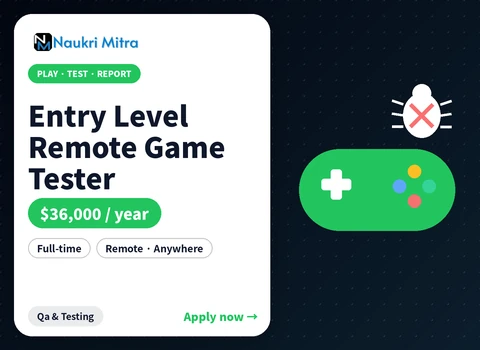
Entry-Level Remote Game Tester
This is a full-time, fully remote quality assurance position paying $36,000 a year, with the listing open to applicants anywhere in the world. It sits in the QA & Testing category, and the day-to-day work is exactly what it sounds like: playing games closely enough to notice what a normal player would miss.
Game testers on this team play through builds before they reach the public, looking for anything that would break the experience once real players get their hands on it. That covers straightforward bugs, visual glitches, broken triggers, and gameplay that just doesn't behave as intended by the design. When a fix comes back from development, the same tester usually checks it again before it's considered closed.
What you'll be doing
- Play through games methodically to catch bugs, glitches, and gameplay issues before they reach players
- Log every finding in a bug tracking system with enough detail that a developer can reproduce it without guessing
- Retest fixes once they come back from development to confirm the issue is actually resolved before it ships
Some days are focused entirely on one small area of a game, checked over and over from different angles. Other days involve a broader pass across a whole build ahead of a milestone. Both are part of the job, and the pace tends to pick up noticeably in the weeks leading up to a release date. Issues found on the job range widely: a texture that fails to load, a save file that corrupts after a specific sequence of actions, dialogue that doesn't trigger, or a multiplayer session that drifts out of sync between players. None of these show up in a script the way a scripted test case would, which is part of why the role leans on a human playing the game rather than automated checks alone.
What you need to bring
The minimum education requirement is a high school diploma or its equivalent, so a college degree isn't required here. Experience-wise, the posting asks for two months, which puts it closer to a genuine game tester job with no experience required than most listings in this category. Prior QA or testing work helps, particularly with bug-tracking software, but it isn't required to apply. What tends to matter more than a resume line is whether a candidate can sit down with an unfamiliar build and clearly describe what went wrong so that someone else doesn't need to ask a dozen follow-up questions.
- Comfort working inside bug tracking software on a daily basis
- Attention to detail sharp enough to catch something most players would scroll right past
- Familiarity with gaming platforms, across whatever consoles or systems the current project touches
- Written communication clear enough that a bug report reads the same way to whoever opens it next
- Patience, since testing often means repeating the same section a dozen times to catch something rare
Naukri Mitra tends to see a mix of full-time and contract postings in this category, and this particular role falls on the full-time side of that split, which is also why it carries a fixed annual salary rather than an hourly contract rate.
Pay and benefits
Full-time staff in this role typically receive health coverage and paid time off, along with the remote-work flexibility built into a fully home-based position. Some employers go a step further and add a wellness stipend or a home office equipment allowance for remote staff on top of the base package.
- Health coverage
- Paid time off
- Remote-work flexibility
- Wellness stipend or home-office equipment allowance, offered by some employers
For many people, this is how they become remote game testers in the first place. The entry bar is short: two months of relevant experience, plus the kind of patience it takes to sit with the same section of a game far longer than any regular player would. It's less about a résumé full of shipped titles and more about proving you notice things other people don't.
The team leans on the bug tracking system as the shared record of what's broken, what's fixed, and what's still open, so clear written notes matter as much as catching the bug in the first place. A report that's vague or missing steps to reproduce ends up costing someone else time later, which is part of why written communication is listed as a required skill rather than a nice-to-have. A good bug report usually includes what platform it happened on, exactly what steps led to it, and what should have happened instead.
Because the position is listed as remote and open to applicants worldwide, location isn't a filter here the way it is for most on-site QA roles. Time zones can matter more than geography, since a small team still needs some overlap for handoffs and questions during an active testing cycle. What matters most day-to-day is whether someone can work independently and stay organized in a tracker that might hold dozens of open items at once, especially during the more repetitive stretch of a project. Anyone weighing a game tester remote salary against other entry-level options should factor in that this one comes with benefits attached, not just an hourly rate.
Growth from here usually runs toward more senior QA work: leading a tester on a title, moving into test planning, or shifting toward automation once someone has enough manual testing experience to know what's actually worth automating. None of that is guaranteed, and it depends heavily on the studio, but it's a fairly typical path for people who start in a role like this.
Applications are reviewed on a rolling basis, and candidates who make it past an initial screen can expect a short practical exercise involving an actual build, since that's a more reliable signal for this role than a resume alone. Given the remote setup, most of the process happens over email and video calls rather than in person, and new hires typically start with a shorter, more supervised assignment before moving onto a full build on their own.