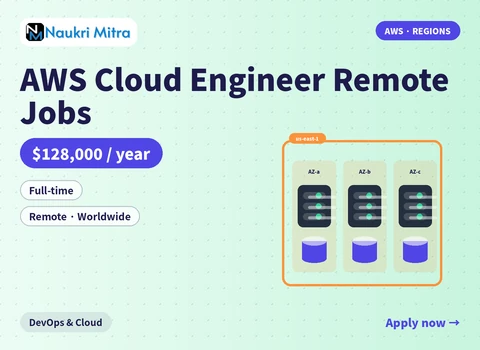
AWS cloud engineer, remote, $128,000 a year, open to anyone qualified regardless of where they live. Full-time, under DevOps and cloud infrastructure, focused specifically on AWS rather than a multi-cloud setup spanning several providers.
Companies that standardize on a single cloud provider tend to want engineers who know that platform deeply rather than broadly across several. This role reflects that preference. The work assumes real fluency with AWS's service catalog and the ways those services interact, not a general cloud background applied to whatever platform happens to be in use.
The work
- Design, deploy, and maintain infrastructure on AWS
- Automate provisioning with infrastructure-as-code tools
- Monitor systems for performance and cost efficiency
Infrastructure-as-code work here mostly runs through Terraform or CloudFormation, and CloudFormation in particular tends to get stuck in ways that AWS's own tooling doesn't always resolve cleanly. A stack update that fails partway through can land in an UPDATE_ROLLBACK_FAILED state, refusing further changes until someone manually identifies which resource actually broke and fixes it directly. That kind of troubleshooting is routine here, not an edge case reserved for a bad week.
Cost efficiency monitoring means going beyond the AWS billing dashboard's default view. An EC2 instance left running after a test environment was supposed to be torn down, or an S3 bucket accumulating old snapshots nobody's cleaning up, can quietly add real cost over months without anyone noticing until the monthly invoice jumps.
Lambda functions bring their own quirks to the monitoring picture. A function that works fine under light traffic can start showing cold-start latency spikes once invocation patterns change, and diagnosing whether that's a memory allocation issue, a dependency loading problem, or just an unavoidable consequence of infrequent invocation takes real familiarity with how the Lambda execution environment actually behaves.
Requirements
Education-wise, the ask is a bachelor's degree, most often earned in computer science. Candidates need 30 months of hands-on experience specifically managing AWS infrastructure, along with an AWS certification such as Solutions Architect Associate. Scripting and automation skills are expected as a baseline, not something to build up after joining.
- AWS services: EC2, S3, Lambda
- Infrastructure as code, Terraform or CloudFormation
- Linux
- Scripting
- Networking
A higher-level AWS certification, such as Solutions Architect Professional or DevOps Engineer Professional, tends to stand out from the more common Associate-level credential. Experience with AWS CDK for infrastructure defined in code rather than YAML templates is worth mentioning, as is any background in managing multi-account setups through AWS Organizations, which often comes up once a company's AWS footprint grows beyond a single account.
Observability tooling specific to AWS, like CloudWatch and X-Ray, is also worth having on a resume, since general monitoring knowledge doesn't always translate directly to how these tools surface information. Someone who's actually traced a slow request through X-Ray to find the exact service adding latency has a different kind of practical fluency than someone who's only read about distributed tracing conceptually.
Compensation
The role pays $128,000 annually. The standard package covers medical coverage, paid time off, and a matching 401(k) contribution, and certification reimbursement is included as well, which matters given how often AWS refreshes its exam content. Larger employers hiring at this level sometimes add tuition reimbursement or a learning stipend to the base package, though that depends on the specific company.
- Health insurance
- Paid time off
- 401(k) matching
- Certification reimbursement
Working inside a single cloud ecosystem
Specializing in AWS rather than working across multiple providers has real tradeoffs worth understanding going in. Naukri Mitra sees this specialization pay off for candidates who go deep into IAM policy design, VPC architecture, and the specific quirks of services like Lambda, since that depth is harder to build when attention is split across AWS, Azure, and GCP simultaneously. The tradeoff is narrower transferability if a future employer runs on a different platform entirely.
IAM permissions deserve particular attention in this role. A policy written too broadly can grant more access than intended, and a policy written too narrowly can break a service in production the moment it tries to do something the original permissions didn't anticipate. Getting that balance right takes real familiarity with how AWS's permission model behaves in practice, not just theoretical knowledge of the syntax.
Networking within AWS follows its own logic too, one that doesn't always map cleanly onto general networking knowledge. VPC peering connections, route table configuration, and Transit Gateway setups for connecting multiple VPCs each come with specific constraints that only become obvious through hands-on troubleshooting, usually the first time a connection that should work quietly doesn't.
Applying
People asking how to become a remote AWS cloud engineer typically start by earning a Solutions Architect Associate certification, then build hands-on experience managing real infrastructure rather than just lab environments, since certifications alone rarely convince a hiring manager without production experience backing them up. Thirty months of that kind of hands-on work is the bar for this particular opening, and candidates without at least some of that time spent on live, customer-facing infrastructure should expect that gap to come up directly during screening.
The interview process for a role like this usually includes a technical conversation that walks through a real AWS architecture decision, so candidates should come prepared to explain not just which services they've used but why a particular combination made sense for a specific problem. AWS cloud engineer remote salary at this experience level generally rewards that kind of applied judgment more than certification count alone. Weighing Lambda's cold-start latency against the operational overhead of an EC2-based alternative, and landing on a clear reason for the final choice, is the kind of decision this role calls for regularly, and it makes for a far more useful interview conversation than a straight list of services used.